Chinese Herbs for Hormone Symptoms by TCM Pattern
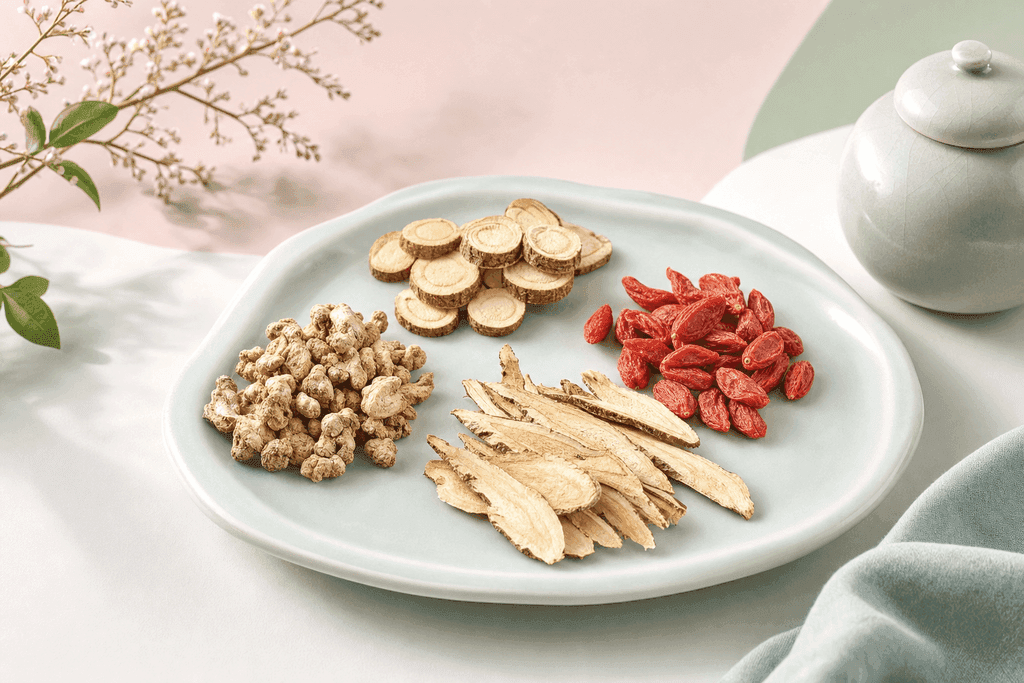
Your doctor runs a full hormone panel and everything comes back normal, but you still wake up drenched in sweat at 3 a.m. or skip periods for three months straight. In Chinese Herbal Medicine, two people with identical symptoms often need completely different herbs because the treatment targets your underlying pattern, not just the hormone imbalance itself. Understanding which pattern is driving your symptoms is the difference between herbs that work and ones that sit unused in your cabinet.
How Pattern Diagnosis Works in Chinese Herbal Medicine
When you visit a regular doctor for hormone issues, they usually run blood tests to check specific hormone levels. Chinese medicine takes a completely different approach. Instead of focusing on isolated lab numbers, practitioners look at your whole body as a connected system. They examine how different symptoms cluster together to reveal what's actually going on beneath the surface. This method has been used for thousands of years to identify and treat hormone-related problems, long before modern blood tests even existed.
What Makes Pattern Diagnosis Different
Pattern diagnosis groups your symptoms into meaningful categories that point to specific imbalances. Two people might both have irregular periods, but one person's pattern could involve heat and dryness while another's involves cold and dampness. The same hormone symptom can come from totally different root causes, which is why the same herbal formula doesn't work for everyone.
Here's what practitioners look at when determining your pattern:
Energy flow throughout your body and whether it's stuck or moving freely
Temperature signs like feeling too hot, too cold, or alternating between both
Which organ systems are out of balance based on symptom location and timing
Moisture levels showing up as dryness, excess fluids, or dampness
How Practitioners Assess Your Pattern
Licensed herbalists use specific diagnostic tools that might seem unusual at first. They look at your tongue coating and color, feel the quality of your pulse at different positions, and ask detailed questions about your symptoms. The traditional approach to menstrual health shows how these assessment methods reveal patterns that blood tests might miss entirely.
Diagnostic Method | What It Reveals | Example Finding |
|---|---|---|
Tongue examination | Heat, cold, dampness | Red tip shows heart fire |
Pulse reading | Energy quality and flow | Wiry pulse indicates stagnation |
Symptom timing | Affected organ systems | Night sweats point to yin deficiency |
Our Signature Formula uses this exact pattern-based approach through an online quiz reviewed by licensed herbalists. Instead of guessing which chinese herbs for hormone balance might help, you get a formula matched to your specific pattern. The herbs work together to address your root imbalance, not just cover up surface symptoms.
Kidney Yin Deficiency Pattern and Hormone Symptoms
In Chinese Herbal Medicine, the body's cooling and nourishing reserves are called Yin. When these reserves run low, you get symptoms that feel like your internal thermostat broke. This pattern shows up most often during perimenopause, but it can also appear after years of pushing through stress, skipping meals, or burning the candle at both ends. The body simply runs out of the resources it needs to stay cool and calm.
Kidney Yin deficiency is the most common pattern behind hot flashes, night sweats that soak through your sheets, insomnia where you wake up between 1 and 3 AM, and anxiety that feels like it comes from nowhere. Your labs might look fine, but your body is telling a different story.
Symptom | Traditional Observation |
|---|---|
Night sweats | Heat rising from depleted reserves |
Hot flashes | Yin unable to anchor Yang |
Insomnia | Heart not rooted by Kidney |
Dry skin or eyes | Fluids not nourishing tissues |
Anxiety | Spirit unanchored |
The herbs used for this pattern focus on nourishing and cooling. Rehmannia (Shu Di Huang) builds the deep reserves, Cornus (Shan Zhu Yu) prevents leaking of resources, and Dioscorea (Shan Yao) supports the body's ability to transform what you eat into usable energy. These herbs appear in Liu Wei Di Huang Wan, a classical formula that has been used for centuries to address this exact pattern.
Treatment does not just cool you down. It rebuilds what has been depleted over time, which is why results build gradually rather than overnight.
Liver Qi Stagnation Pattern and Hormone Symptoms
If your symptoms get worse when you are stressed, this is probably your pattern. In Chinese Herbal Medicine, the Liver is responsible for smooth flow throughout the body, including hormones, emotions, and digestion. When that flow gets stuck, everything backs up like traffic on a highway. You might notice breast tenderness before your period, cycles that show up early or late without warning, or digestive issues that come and go based on your stress level.
This pattern is not about your actual liver organ. It is about the body's ability to move things where they need to go without getting jammed up.
Irritability that feels like it is just under the surface
PMS symptoms that are worse some months than others
Sighing without realizing it
Digestive bloating that gets worse with stress
Tension headaches at the temples or behind the eyes
Emotional constraint and chronic stress are the main drivers of this pattern. When you cannot express what you feel or you are constantly managing other people's needs before your own, the body holds that tension. Over time, it shows up as physical symptoms.
The herbs used here focus on moving what is stuck. Bupleurum (Chai Hu) smooths the flow of Liver Qi, White Peony (Bai Shao) relaxes tension and nourishes Blood, and Cyperus (Xiang Fu) specifically addresses stagnation in the lower abdomen. The classical formula Xiao Yao San combines these herbs with Blood-nourishing ingredients because stagnation often happens when there is not enough nourishment to keep things moving smoothly.
Spleen Qi Deficiency Pattern and Hormone Symptoms
This pattern shows up when your body cannot turn food into usable energy anymore. You eat a meal and feel more tired instead of energized. You might have bloating that makes you look six months pregnant by the end of the day, loose stools that never quite resolve, or periods so heavy you have to plan your life around them. In Chinese Herbal Medicine, the Spleen is responsible for transforming what you eat into Qi and Blood, and when it is weak, everything downstream suffers.
Chronic dieting, skipping meals to get through your workday, or years of digestive issues can all lead to this pattern. Your body is working hard but not getting the building blocks it needs.
Symptom | Traditional Understanding |
|---|---|
Fatigue after eating | Spleen struggling to transform food |
Bloating | Qi not moving fluids |
Loose stools | Spleen not separating clear from turbid |
Heavy periods | Spleen not holding Blood |
Brain fog | Qi not rising to nourish head |
The herbs for this pattern focus on building and strengthening. Ginseng (Ren Shen or Dang Shen) tonifies Qi, Atractylodes (Bai Zhu) strengthens the Spleen's ability to transform and transport, and Astragalus (Huang Qi) lifts what has collapsed. Bu Zhong Yi Qi Tang and Si Jun Zi Tang are the foundational formulas used here, often combined with Blood-building herbs if heavy bleeding is part of the picture.
This is not about eating more or eating less. It is about restoring your body's ability to use what you give it.
Combined Patterns and Complex Presentations
Here is what most practitioners will not tell you upfront. Almost nobody fits neatly into one pattern. You might have Liver Qi stagnation with Spleen Qi deficiency, which means you are stressed and your digestion is a mess. Or you might have Kidney Yin deficiency with Liver Qi stagnation, so you are getting hot flashes and you are irritable. The body does not read textbooks, and symptoms overlap in ways that require someone trained to untangle them.
This is where Chinese herbs for hormone balance get interesting. Licensed herbalists do not just pick a formula off the shelf. They modify classical formulas based on which pattern is causing the most trouble right now and which patterns are contributing in the background.
Pattern priority determines which herbs form the foundation of your formula
Secondary patterns are addressed with supporting herbs
Formulas are adjusted as your body changes and symptoms shift
Most people need a combination approach rather than a single-pattern formula
Our Signature Formula is matched to your specific pattern combination through an assessment and reviewed by a licensed herbalist before it ships. You take a quiz at pattern.jadewell.me that asks about your symptoms, and the formula you receive is built for your body, not a generic blend.
This matters because taking the wrong formula for your pattern can make things worse. If you have Spleen Qi deficiency and you take herbs that are too cooling, you will feel more tired. If you have Kidney Yin deficiency and you take herbs that are too warming, your night sweats will get worse. Research on Chinese Herbal Medicine for hormone symptoms shows that pattern-based treatment produces better outcomes than one-size-fits-all approaches, which is why assessment matters so much.
Why Pattern Matching Matters More Than Symptom Matching
Here's something most people don't realize when they start looking into chinese herbs for hormone balance: the same herb that helps one person can actually make another person worse. This isn't because the herb is bad or because one person is doing something wrong. It's because Traditional Chinese Medicine works on patterns, not just symptoms. Two people with fatigue might need completely different herbs based on their underlying pattern, and taking the wrong one can set you back weeks or even months.
Think of it like this. If you have fatigue from Spleen Qi deficiency, your body is already running cold and sluggish. Taking cooling herbs because you read they help with hormone issues will make you feel even more tired and cold. Your digestion gets worse, you gain weight easier, and you wonder why the herbs aren't working.
Cooling herbs can worsen cold patterns even when symptoms seem to match
Moving herbs deplete people who are already deficient of Qi or Blood
Warming herbs overheat those with Yin deficiency or internal heat
Tonifying herbs can create stagnation in someone who needs movement first
This is exactly why pattern diagnosis matters so much. Licensed herbalists spend years learning to identify these patterns through pulse reading, tongue diagnosis, and detailed health history. They know which traditional Chinese medicine herbs work together and which ones contradict each other based on your specific pattern.
Pattern assessment prevents wasting time on formulas that won't help you
Herbalists modify classical formulas to match your exact presentation
Professional review catches potential herb interactions or contraindications
This is why our Signature Formula requires both a pattern assessment quiz and herbalist review before shipping. We're not just matching symptoms to herbs. We're identifying your underlying TCM pattern and selecting a classical formula that addresses the root cause of your hormone symptoms, not just covering them up.
Getting Started with Pattern-Based Treatment
The reason hormone symptoms feel so different from person to person is because they come from different patterns. Two people with irregular cycles might need completely different chinese herbs for hormone balance, depending on whether their pattern shows heat, cold, stagnation, or deficiency. This is why generic hormone supplements often miss the mark, and why pattern diagnosis matters so much in Chinese Herbal Medicine.
Understanding your specific pattern is the first step toward treatment that actually addresses what your body needs. A licensed herbalist looks at your symptoms as a whole picture, not isolated complaints. They consider your energy levels, digestion, sleep quality, temperature preferences, and dozens of other details that reveal which pattern is driving your symptoms.
Most people cannot access an in-person practitioner who specializes in Chinese Herbal Medicine, especially one trained in pattern diagnosis. Our Signature Formula bridges that gap by matching you to a classical formula through a detailed assessment, then having a licensed herbalist review your specific case before anything ships. The formula you receive is tailored to your pattern, not just your main complaint.
Pattern-based treatment works differently than symptom suppression. It addresses the root imbalance that allows symptoms to persist, which is why the approach has been refined over centuries of clinical observation. You can take the pattern quiz to see which pattern matches your experience, though a full herbalist review gives you the most accurate match.
The questions that come up most often about starting Chinese Herbal Medicine involve safety, timing, and what to expect. Those details matter, especially if you are already taking medications or have tried other approaches without success.
Common Questions About Pattern-Based Herbal Treatment
Getting started with pattern-based herbal treatment can feel confusing at first. Most people have similar questions about how the process works, whether it's safe, and what to expect. Here are the answers to the most common questions we hear about using chinese herbs for hormone balance based on your specific TCM pattern.
How do I know which pattern I have?
You can find out your pattern by taking a detailed quiz that asks about your symptoms, energy levels, digestion, sleep, and other health factors. Our Signature Formula includes a pattern quiz that gets reviewed by a licensed herbalist to make sure you're matched correctly. You don't need to diagnose yourself because the quiz and herbalist review handle that part for you.
Can I have more than one pattern at the same time?
Yes, it's actually pretty common to have overlapping patterns. Your body might show signs of both Liver Qi Stagnation and Blood Deficiency, for example. A good pattern assessment looks at your primary pattern and any secondary patterns that need attention. The herbal formula gets customized to address what your body needs most right now.
Are Chinese herbs safe to take with my medications?
Chinese herbs can interact with certain medications, so it's important to check with both your doctor and herbalist before starting. Always share your complete medication list when getting a pattern assessment. Most people can safely use herbs alongside their medications, but some combinations need to be avoided or adjusted.
How long does it take to see results from pattern-matched herbs?
Most people notice some changes within 2-4 weeks, though deeper shifts in hormone balance can take 2-3 months. Chinese medicine works gradually to address root causes rather than just covering up symptoms. Some symptoms like sleep or energy might improve faster, while hormonal changes take a bit longer to stabilize.
Do I need to see an in-person practitioner to get pattern-matched herbs?
Not anymore. While seeing someone in person is great, you can now get pattern-matched formulas online through services that include herbalist review. This makes it easier to access quality herbal treatment no matter where you live.
What if my pattern changes over time?
Your pattern will likely shift as your symptoms improve or as your life circumstances change. That's why it's helpful to reassess your pattern every few months. Your herbal formula should adapt as your body's needs change, not stay the same forever.